“They said they’d find a way — and they did.”
When Mark Ormrod first considered joining Freemasonry, it wasn’t the ceremony or tradition that drew him in. It was something simpler.
“It sounded like it aligned with my values… just people who wanted to be around good people.”
A former Royal Marine and Invictus Games athlete, Mark is now a member of Royal Marines Plymouth Lodge No. 9528 in Devonshire — a Lodge with strong connections to service and camaraderie.
At the time, Mark was still serving in the Royal Marines. The Lodge he was introduced to reflected much of what he already knew: discipline, shared experience, and a deep sense of brotherhood.
But life would soon change in ways no one could have anticipated.
A life-changing moment
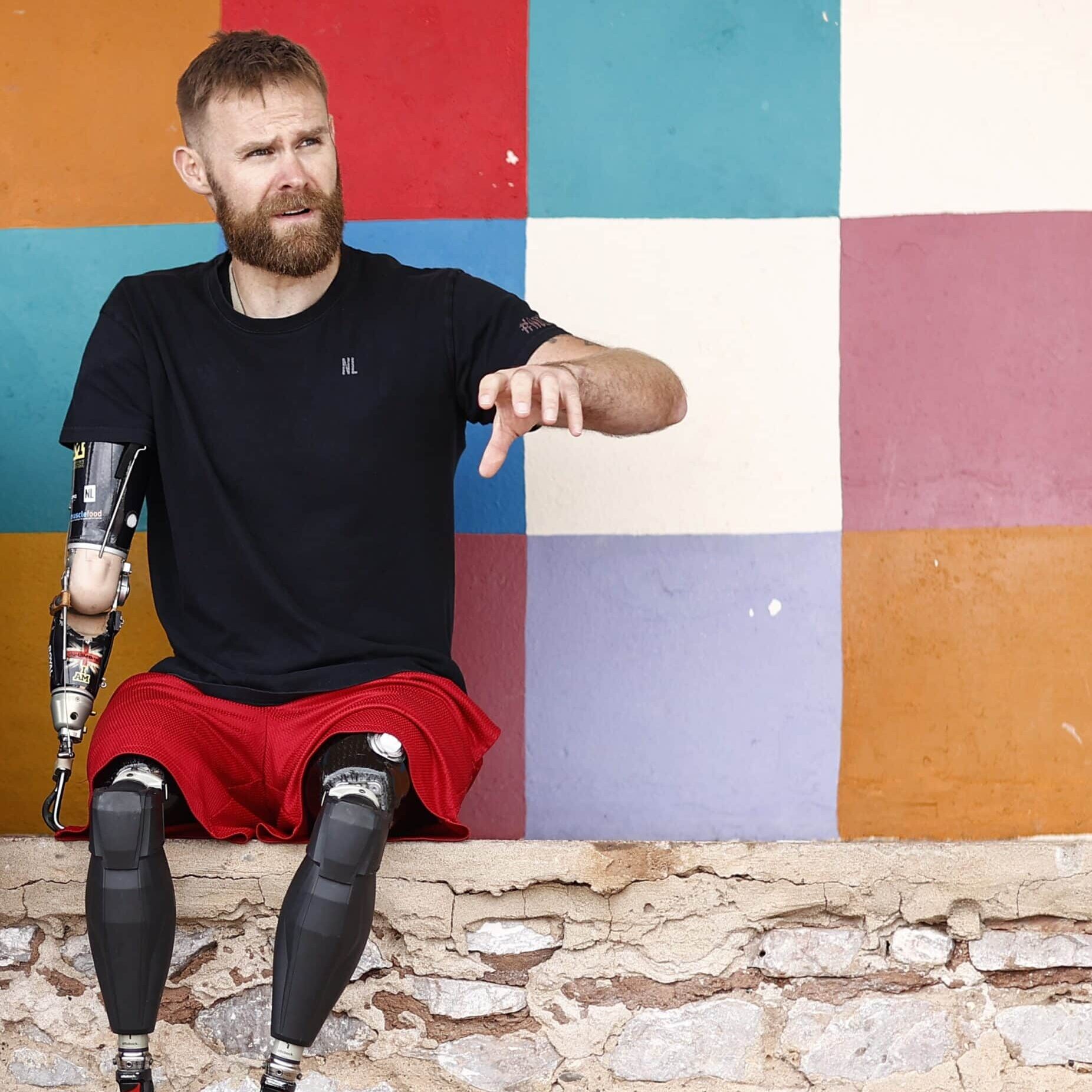
In December 2007, during a tour of Afghanistan, Mark was second in command of an eight-man patrol returning to camp when he stepped on an improvised explosive device.
In an instant, everything changed.
He lost both legs and his right arm. At one point, he was declared clinically dead.
But what Mark remembers most from that moment is not fear.
It was something entirely unexpected.
A deep sense of calm.
“There was no panic,” he recalls. “No fear. Just peace.”
In what could have been his final moments, he experienced a clarity that would stay with him long after his recovery began — a feeling that there was something beyond the immediate reality of what was happening.
“It opened my mind,” he says. “It made me think there’s something more than this life.”
That experience didn’t just mark the end of one chapter — it reshaped the way he viewed everything that followed.
His recovery would be long and demanding, both physically and mentally. But alongside that shift, there was a greater sense of purpose, resilience, and openness to new experiences.
It was during this period, in the early stages of rebuilding his life, that Freemasonry re-entered his life.
An unexpected invitation
During his rehabilitation, Mark received a question that might have seemed unlikely given everything he had been through:
Was he still interested in joining Freemasonry?
The answer he received mattered just as much as the question.
“Whatever issues there were with my injuries, they said they’d work around it… and make sure I could still take part fully.”
There was no hesitation. No suggestion that it might be too difficult.
Just a commitment: we’ll find a way.
Finding a way
From the very beginning, that promise was put into action.
Before his initiation, members of the Lodge spoke with Mark in detail — not about limitations, but about possibilities.
“They’d ask me: can you do this? Can you do that? Then they’d go away and rehearse a new way of doing things.”
What followed was a carefully thought-out approach — mostly planned, but always flexible.
His first ceremony took place in a wheelchair, with fellow members guiding and supporting him. As he progressed through his rehabilitation, so too did his experience in Freemasonry.
For his next steps, he stood on early prosthetics, learning again to balance, to move, to trust his body. Later still, on full-length prosthetic legs, he continued his journey, adapting as he went alongside the Lodge.
But what is less visible is the effort behind those moments.
As Mark prepared for each stage of his journey in Freemasonry, he was also rebuilding his strength and confidence outside of the Lodge. Learning to use prosthetics is not simply about standing or walking — it requires balance, coordination, and sustained physical effort.
Each ceremony became, in a sense, a milestone — something to work towards.
As he progressed, he focused on building the strength needed to take part more fully — not just to be present, but to actively participate. It was a gradual process, shaped by determination, patience, and a clear sense of purpose.
“It wasn’t perfect… but it didn’t need to be.”
What mattered was that he was there. Taking part. Moving forward.
In many ways, Freemasonry did not just adapt to Mark — it gave him something to aim for.
The moment it clicked
After his first ceremony, Mark remembers walking — or rather, being wheeled — into a room filled with over a hundred people.
“They were all just wishing me well, congratulating me, welcoming me in.”
In that moment, any uncertainty disappeared.
“I knew then that this was the right choice.”
More than adjustments
The changes made to support Mark weren’t just practical — they were human.
Sometimes that meant someone stepping in to assist. Sometimes it meant rethinking how a space was used. Sometimes it meant simply allowing things to be done differently.
“As long as I could do the important parts… people would step in to help.”
Over time, Mark himself adapted too — learning how to work with his prosthetics, refining how he carried out certain actions, finding ways to make things feel more natural.
It became a shared process. Not perfect. But effective.
A two-way street
For Mark, one of the most important lessons is that inclusion isn’t one-sided.
“It’s a two-way street,” he explains. “You’ve got to give as much information as you can… and the Lodge does as much as they possibly can.”
No two situations are the same. What works for one person may not work for another. The key is communication — honest, practical, and ongoing.
Changing perceptions
Interestingly, not all challenges are physical.
“There were times I felt self-conscious,” Mark admits. “People might not even realise I’m missing limbs under a suit… and I’d worry they thought I was doing things wrong.”
But those moments often led to conversations — and those conversations led to understanding.
“It actually has a positive effect… it shows how inclusive things can be.”
Growth beyond expectation
Freemasonry didn’t just accommodate Mark — it challenged him.
Learning ritual. Taking on responsibility. Progressing through roles. Holding himself to high standards.
“It’s given me confidence… discipline… It’s brought a lot to my life.”
There’s a quiet pride in his words — not just in what he has overcome, but in what he continues to achieve.
“You’re part of something bigger… a group of people with shared values.”
Looking forward
Ask Mark whether Freemasonry is inclusive, and he gives a thoughtful answer.
“It is…, but it’s also always evolving.”
Because inclusion isn’t static. It adapts — just as Lodges adapt to the people within them.
He imagines a future where accessibility is built in from the start: spaces designed to work for everyone, without needing obvious modifications. Subtle, thoughtful, and natural.
Simple advice, powerful impact
For Lodges wondering where to start, Mark keeps it simple:
“Listen.”
Do not assume. Do not generalise. Not a guess.
“Just ask the person — what can you do? What do you need? Then work from there.”
“It’s a shared responsibility — the individual should explain what they need, and the Lodge should do everything it reasonably can to accommodate that.”
For those still unsure
And for anyone hesitating — wondering if Freemasonry is for them — his message is direct:
“Go and try it.”
“If something’s sparked your curiosity, follow it. It’s a wonderful organisation… it builds confidence, friendships, and brings you out of your shell.”
No barriers, just people
Mark’s story is not just about overcoming barriers within Freemasonry.
It is also about what becomes possible when those barriers are not allowed to define the experience in the first place — when people choose to focus on what can be done, rather than what cannot.
In his case, nothing about Freemasonry was fundamentally changed. The principles, the ceremony, and the traditions remained the same. What changed was the approach — the willingness to adapt, plan, listen, and work together so that those traditions could still be experienced fully.
Because at its core, Freemasonry is not about perfection.
It is not about everything being done in exactly the same way for everyone, regardless of circumstance. It is about people — and recognising that every individual brings something different, valuable, and unique to the organisation.
Mark’s journey shows that inclusion is not a compromise on tradition. It is an expression of it.
When people come first, barriers do not necessarily need to be broken down — they simply stop defining what is possible.
And in that space, there is always a way.